27 Jul 2026
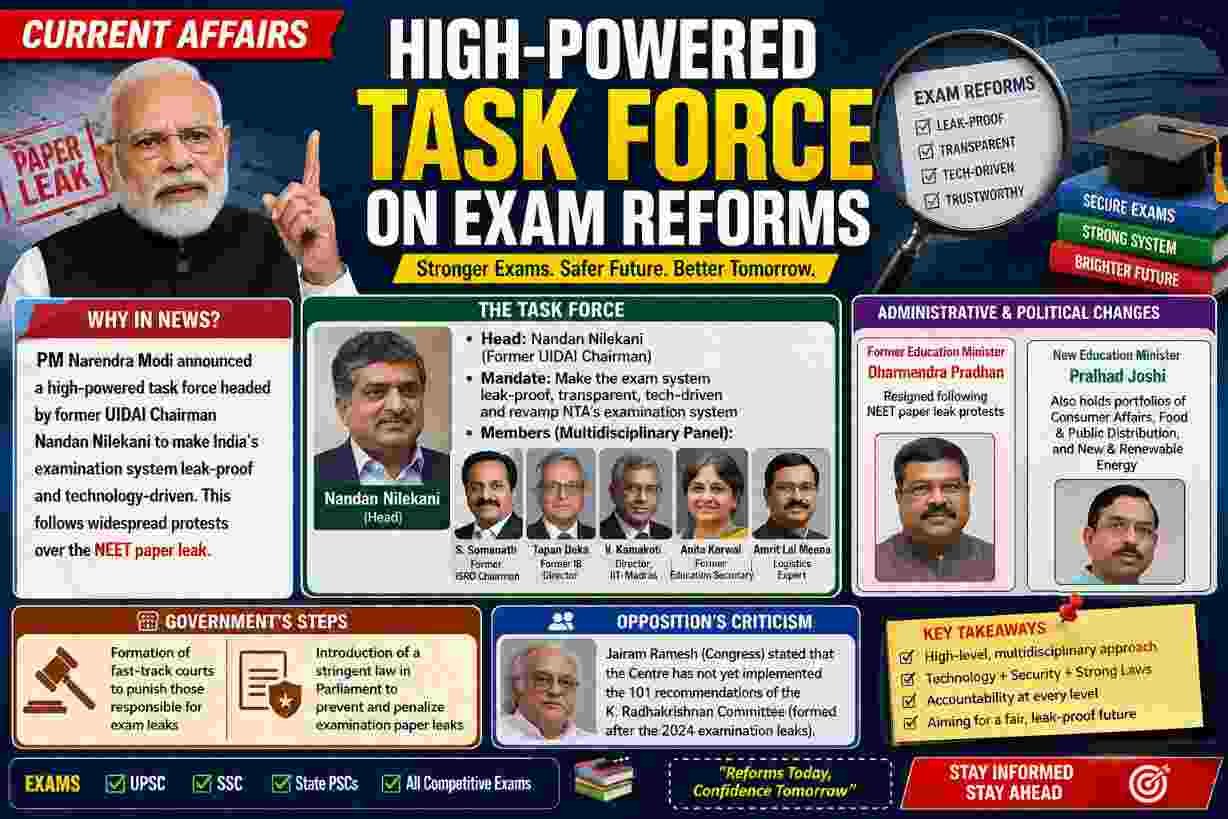
Why in News? Prime Minister Narendra Modi announced the formation of a high-powered task force, headed by former UIDAI Chairman Nandan Nilekani, to make India’s examination system leak-proof and technology-driven. This follows widespread protests over the NEET paper leak.
Key Facts to Memorize (Prelims Focus)
1. The Task Force:
Head: Nandan Nilekani (Former UIDAI Chairman).
Mandate: Recommend steps to make the examination system leak-proof, transparent, tech-driven, and revamp the National Testing Agency’s (NTA) examination system.
Members (Multidisciplinary Panel):
S. Somanath: Former ISRO Chairman.
Tapan Deka: Former IB (Intelligence Bureau) Director.
V. Kamakoti: Director, IIT-Madras.
Anita Karwal: Former Education Secretary.
Amrit Lal Meena: Logistics expert.
2. Administrative & Political Changes:
Former Union Education Minister: Dharmendra Pradhan (resigned following NEET paper leak protests).
New Union Education Minister: Pralhad Joshi (also holds Consumer Affairs, Food and Public Distribution, and New and Renewable Energy).
3. Government Legislative/Judicial Steps:
Formation of fast-track courts to punish those responsible for exam leaks.
Introduction of a stringent law in Parliament regarding examination paper leaks.
4. Opposition’s Criticism:
Jairam Ramesh (Congress): Stated that the Centre has not yet implemented the 101 recommendations of the K. Radhakrishnan Committee (formed after the 2024 examination leaks).
Probable Prelims Questions (MCQs)
Q1. With reference to the recent task force constituted for exam reforms, consider the following statements:
The task force is headed by former ISRO Chairman S. Somanath.
It aims to revamp the National Testing Agency’s (NTA) examination system.
Former Intelligence Bureau Director Tapan Deka is a member of this panel. How many of the statements given above are correct? A) Only one B) Only two C) All three D) None
Answer: B (Only two) Explanation: Statement 1 is incorrect. The task force is headed by former UIDAI Chairman Nandan Nilekani, not S. Somanath. Statements 2 and 3 are correct based on the provided text.
Q2. According to the opposition, the recommendations of which of the following committees regarding examination leaks are yet to be implemented by the centre? A) K. Radhakrishnan Committee B) Nandan Nilekani Committee C) Anita Karwal Committee D) Yash Pal Committee
Answer: A
Mains Preparation (Descriptive Focus)
Probable Question: "The recent paper leak incidents have severely compromised the credibility of India's examination system. In light of this, discuss the steps taken by the government to restore trust. Also, examine the role a multidisciplinary technology-driven approach can play in reforming the National Testing Agency (NTA)."
 Study Sarthi