Daily Current Affairs

Stay ahead with organized updates across various categories.

Latvian Prime Minister Resigns Over Drone Controversy

Latvian Prime Minister Resigns Over Drone Controversy

15 May 2026
Evika Siliņa resigned as the Prime Minister of Latvia after her coalition government lost its majority in Parliament. The political crisis began when the left-leaning Progressives party withdrew support from the ruling coalition. This happened after Defence Minister Andris Sprūds was removed from his position following controversy over stray Ukrainian drones entering Latvian airspace. The drone incidents raised concerns about national security and border protection in Latvia, which shares regional security concerns because of the ongoing Russia-Ukraine conflict. Evika Siliņa’s resignation is significant because it comes only a few months before Latvia’s general elections. Political analysts believe the incident may affect public opinion and increase pressure on the next government to strengthen defence and security policies. Why is this important? Shows political instability in Latvia before elections Highlights security concerns linked to the Russia-Ukraine war Raises questions about airspace monitoring in European countries May influence Latvia’s future defence policies Key Points Latvian PM Evika Siliņa resigned. Coalition lost majority after partner party withdrew support. Defence Minister Andris Sprūds was removed over drone controversy. Ukrainian drones reportedly entered Latvian airspace. Resignation comes before Latvia’s general elections.
India Criticises Unilateral Sanctions at BRICS Meeting

India Criticises Unilateral Sanctions at BRICS Meeting

15 May 2026
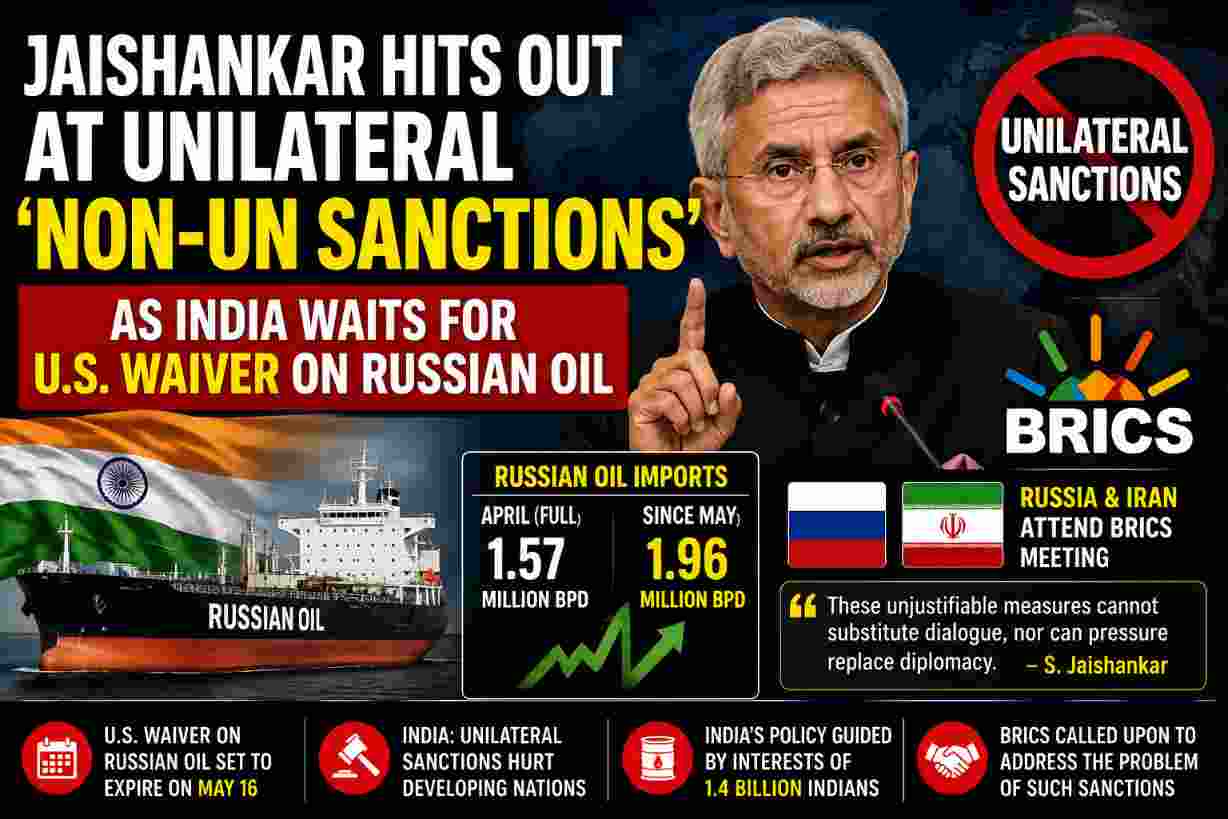
External Affairs Minister S. Jaishankar strongly criticised unilateral sanctions imposed by countries outside the United Nations framework during the BRICS Foreign Ministers’ Meeting held under India’s chairmanship. His remarks came as India awaits the decision of the United States on extending the waiver that allows India to continue importing Russian crude oil despite U.S. sanctions on Russia. Speaking at the BRICS meeting, Jaishankar said that sanctions not approved by the United Nations are “unjustified” and negatively affect developing countries. He stressed that dialogue and diplomacy are better solutions than pressure and coercive measures. The meeting was attended by Russian Foreign Minister Sergey Lavrov and Iranian Foreign Minister Abbas Araghchi, representing two countries heavily affected by U.S. sanctions. According to global shipping data, India’s imports of Russian oil increased sharply in May 2026. Indian refiners are buying more Russian oil because supplies from West Asia are facing disruptions due to tensions around the Strait of Hormuz. Reports suggest Russian oil imports reached around 1.96 million barrels per day in May, compared to 1.57 million barrels per day in April. The U.S. had earlier granted temporary waivers allowing countries like India to import oil from Russia and Iran due to the ongoing West Asia conflict. However, the waiver for Iran has already ended, and the Russian oil waiver is expected to expire soon. India has traditionally opposed unilateral sanctions that are not approved by the United Nations. At the same time, India also balances its foreign policy and energy needs carefully to protect national interests and ensure stable oil supplies for its large population. Why is this important? Highlights India’s independent foreign policy Shows the importance of energy security for India Reflects global tensions affecting oil markets Demonstrates BRICS cooperation on international issues Key Points India criticised non-UN sanctions at the BRICS meeting. S. Jaishankar called unilateral sanctions unjustified. India is waiting for the U.S. decision on the Russian oil waiver. Russian oil imports by India increased in May 2026. West Asia tensions are affecting global energy supplies.
WPI Inflation Jumps to 8.3% in April 2026

WPI Inflation Jumps to 8.3% in April 2026

15 May 2026
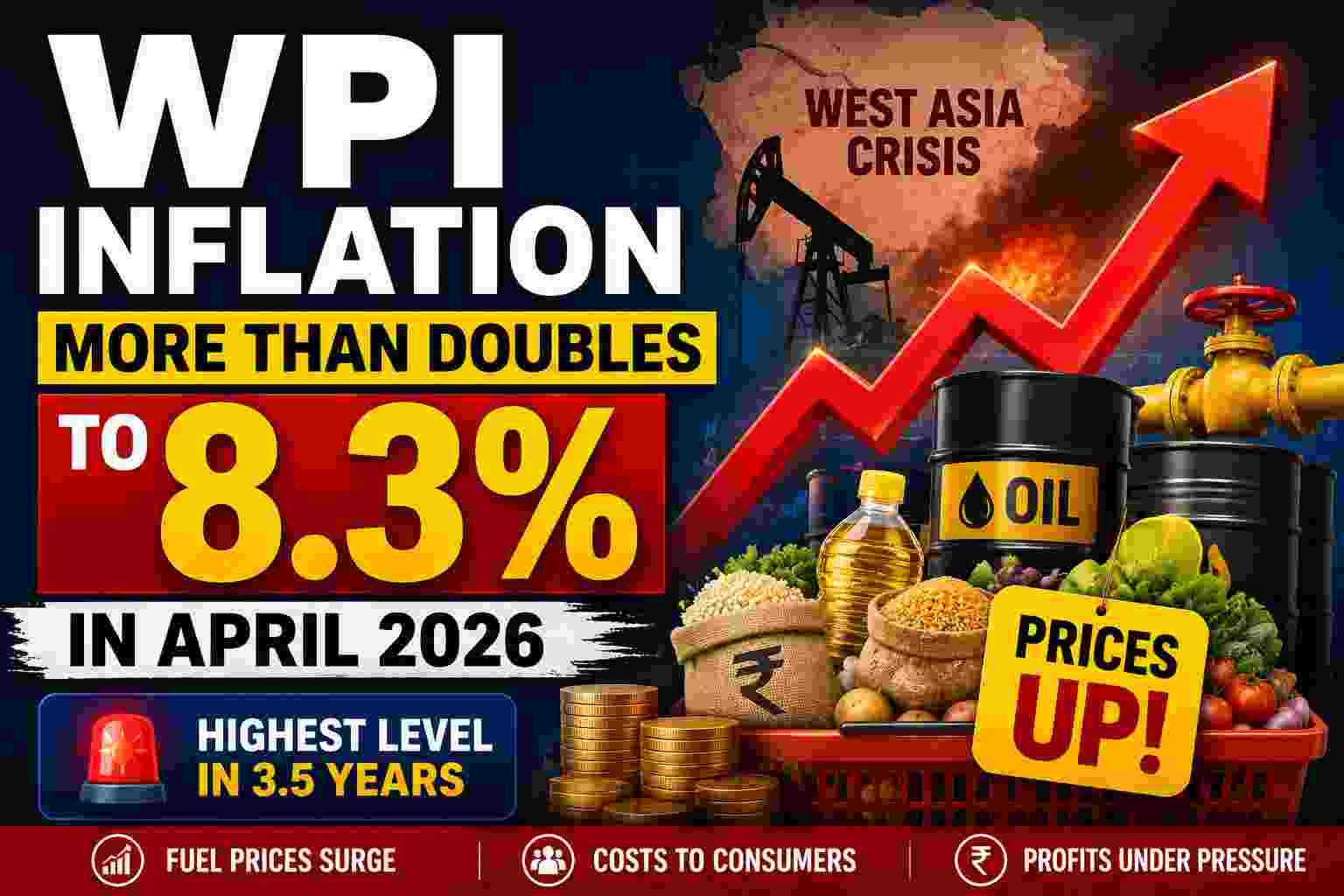
India’s wholesale inflation, measured by the Wholesale Price Index (WPI), rose sharply to 8.3% in April 2026, the highest level in the last 3.5 years. The main reason behind this rise is the increase in crude oil and natural gas prices due to tensions in West Asia. According to data released by the Ministry of Commerce and Industry, WPI inflation was only 3.9% in March 2026. The sharp increase shows the growing impact of global events on the Indian economy. The biggest rise was seen in the crude oil and natural gas sector, where inflation touched 67.2% in April. Fuel and power inflation also increased to 24.7%. Experts say higher fuel prices increase transportation and production costs, which can later make everyday goods more expensive for consumers. Companies may also face lower profits if they are unable to pass these rising costs to customers. However, food inflation at the wholesale level remained low at around 2%, giving some relief. Why is this important? Shows the impact of global conflicts on India’s economy Higher fuel prices may increase prices of daily-use goods Could raise retail inflation in coming months May affect profits of manufacturing companies Key Points WPI inflation rose to 8.3% in April 2026. Highest wholesale inflation in 3.5 years. Crude oil and gas prices were the main reason. West Asia tensions affected global energy prices. Food inflation remained relatively low.
India Back on EU Seafood Export List

India Back on EU Seafood Export List

15 May 2026
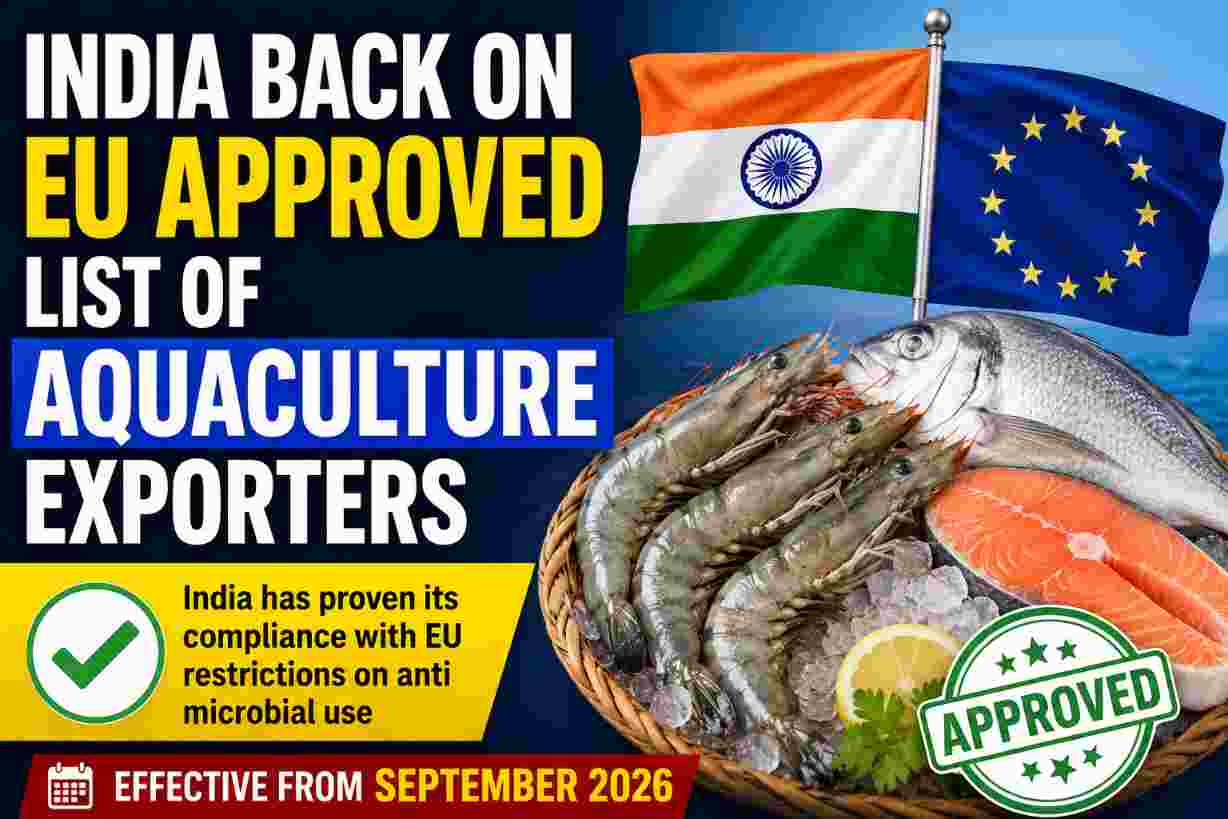
India has received a major boost in the seafood sector. The European Union (EU) has again allowed India to export aquaculture products like fish and shrimp to European countries from September 2026. Earlier, in 2024, the EU had removed India from its approved exporters list because of concerns related to the use of antibiotics and antimicrobials in food-producing animals. Now, India has proved that it follows EU safety rules. These rules do not allow harmful antimicrobial use for increasing animal growth or production. Aquaculture products include: Fish Shrimp and prawns Eels Fish products like caviar This decision is important because the EU is one of the biggest markets for Indian seafood exports. Why is this important? Good news for Indian seafood exporters Helps increase exports and income Creates more opportunities in fisheries sector Improves India’s image in global food safety standards Key Points India is back on the EU approved exporters list. Approval will apply from September 2026. India met EU rules on antimicrobial use. The EU is a major buyer of Indian seafood.
India bans Sugar Exports till Sept 30

India bans Sugar Exports till Sept 30

15 May 2026
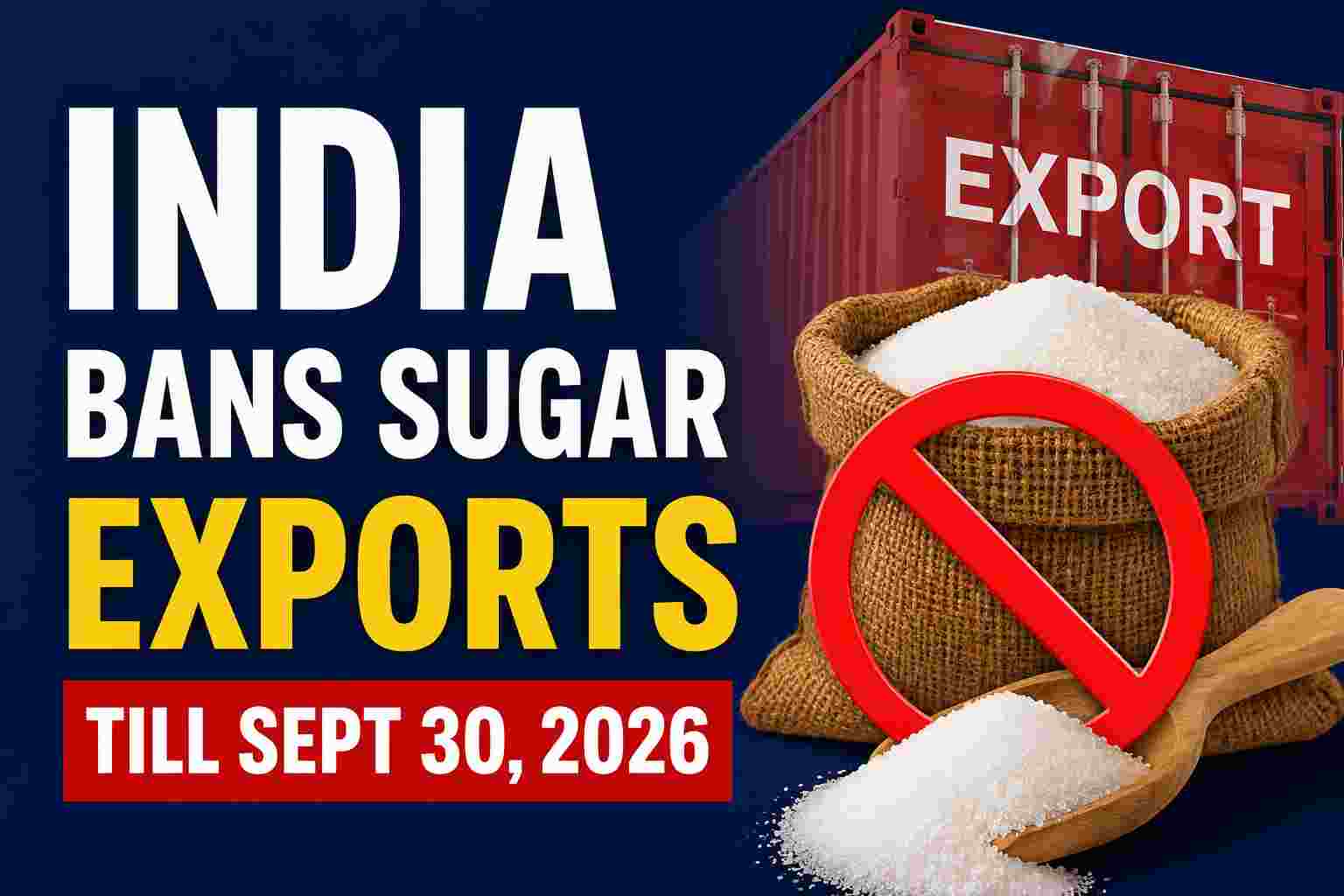
India has tightened sugar export rules by moving sugar from the “restricted” category to the “prohibited” category for exports until September 30, 2026. This means exporters generally cannot ship sugar abroad without special exemptions. Key points from the notification Export of raw, white, and refined sugar is banned. The restriction will remain in force till 30 September 2026. Some exceptions remain: Exports to the United States and European Union under quota systems (CXL and TRQ) Exports under the Advance Authorisation Scheme Government-to-government export deals Shipments already in process before the notification Why did the government take this step? The main reason is concern over lower-than-expected sugar production in the current 2025–26 sugar season. The Indian Sugar and Bio-energy Manufacturers Association (ISMA) had earlier estimated: Total sugar production: 324 lakh tonnes Sugar diverted for ethanol: 31 lakh tonnes Net sugar production: 293 lakh tonnes However, production later weakened in major sugar-producing states like: Maharashtra Uttar Pradesh This reduced the overall output outlook. What does this mean for India? The decision is mainly aimed at: Protecting domestic sugar availability Preventing price spikes in the local market Ensuring enough sugar supply for both consumers and ethanol blending programs India has increasingly been diverting sugarcane toward ethanol production as part of its fuel blending strategy, which also affects sugar availability. Possible impact Domestic sugar prices may remain more stable. Global sugar supply could tighten slightly because India is one of the world’s largest sugar exporters. Sugar mills may face reduced export opportunities, though ethanol production still offers revenue support.
World Health Statistics Report 2026

World Health Statistics Report 2026

15 May 2026
The World Health Organization (WHO) has released its flagship World Health Statistics report, offering a comprehensive look at the global health landscape post-pandemic. This report is a vital resource for understanding Sustainable Development Goal (SDG) progress. 1. The COVID-19 Impact (2020–2023) Excess Deaths: The pandemic is linked to 22.1 million excess deaths globally. The "Hidden" Toll: This figure is 3 times higher than the officially reported deaths, accounting for both direct infections and indirect deaths caused by strained health systems. Life Expectancy: The report highlights a "lost decade," noting that the pandemic reversed 10 years of gains in global life expectancy. 2. Positive Milestones (2010–2024) Despite the pandemic, significant progress was recorded in specific sectors: Infectious Diseases: Global HIV infections dropped by 40%. Neglected Tropical Diseases (NTDs): People requiring interventions fell by 36%. Public Services (2015–2024): 961 million people gained access to safe drinking water. 1.2 billion people gained access to improved sanitation. Lifestyle: A steady decline was noted in both tobacco and alcohol consumption worldwide. 3. Regional Achievements WHO African Region: Outperformed global averages with a 70% reduction in HIV and a 28% reduction in Tuberculosis (TB). South-East Asia Region: On track to reach the 2025 Milestone for Malaria reduction. 4. Major Challenges & Red Flags Malaria: Contrary to other gains, malaria incidence increased by 8.5% since 2015. Women’s Health: Anaemia: Affects 30.7% of women of reproductive age, with no improvement in 10 years. Violence: Intimate partner violence still affects 1 in 4 women globally. 💡 Exam-Oriented Snippets (Quick Revision) Topic Key Statistic / Fact Total Excess Deaths 22.1 Million (2020-2023) HIV Progress 40% Global decline Sanitation 1.2 Billion new users since 2015 Life Expectancy Reversal of 10 years of progress Malaria Trend 8.5% Increase since 2015 📝 Potential MCQ Points: Which region achieved a 70% reduction in HIV infections according to the report? (Ans: WHO African Region) Which women's health issue has shown zero improvement over the last decade? (Ans: Anaemia) Study Tip: Relate this report to SDG 3 (Good Health and Well-being). It provides excellent data for mains-level answers regarding the resilience of global health infrastructure.
Jamuria Mine Disaster (May 2026)

Jamuria Mine Disaster (May 2026)

15 May 2026
The incident at the Kunustoria Padashiya Colliery in West Bengal is a critical case study for students focusing on industrial safety, environmental geography, and public administration. 1. Key Technical Concept: The "Air Blast" Understanding the physics of this disaster is essential for science and technology sections of current affairs. Definition: An air blast is a sudden, violent movement of air within a mine caused by a massive roof fall. The Mechanism: In underground mining (specifically the "Bord and Pillar" method), large empty spaces called voids are left after coal extraction. If these voids are not filled with sand (a process known as sand stowing), the overhead rock layers eventually collapse. This collapse displaces the air in the void instantly, creating a high-pressure shockwave similar to an explosion. In this Case: The collapse of multiple pillars in Section 27 caused the air blast, which led to a secondary landslide inside the mine. 2. Geographical Context: The Raniganj Coalfield Location: Situated primarily in the Paschim Bardhaman district of West Bengal. Historical Significance: It is the cradle of coal mining in India, with the first mining activity recorded in 1774. Economic Profile: It is managed by Eastern Coalfields Limited (ECL), a subsidiary of Coal India Limited (CIL). It provides high-quality non-coking coal used in India's thermal power plants. 3. Regulatory & Institutional Framework Students should be familiar with the bodies responsible for preventing such tragedies: DGMS (Directorate General of Mines Safety): The regulatory agency under the Ministry of Labour and Employment. They are responsible for investigating this accident and enforcing the Mines Act, 1952. ECL (Eastern Coalfields Limited): A public sector undertaking (PSU) headquartered in Sanctoria, West Bengal. CITU (Centre of Indian Trade Unions): A national trade union involved in advocating for worker safety and compensation in this incident. 4. Summary for Fast Revision Feature Details Date & Time Thursday, May 14, 2026, at ~10:00 AM Exact Location Kunustoria Padashiya Colliery, Jamuria, West Bengal Parent Company Eastern Coalfields Limited (ECL) Primary Cause Air blast leading to pillar collapse and landslide Safety Violation Alleged lack of supervision and failure in sand stowing Potential Exam Question Points Environment & Ecology: Discuss the impact of subsidence and landslides in the Raniganj-Asansol belt. Disaster Management: Steps for "Rescue and Relief" operations in deep underground mines (Section 27 was reported to be ~580 feet deep). Ethics: The conflict between production targets in PSUs vs. the implementation of safety measures for labor.
India’s Thomas Cup Bronze (2026)

India’s Thomas Cup Bronze (2026)

14 May 2026
Based on the recent performance and subsequent social media discourse surrounding the Indian men’s badminton team, here is a comprehensive breakdown of the event, the controversy, and its significance for Indian sports. The Achievement: A Podium Finish in Denmark Three weeks ago, the Indian men’s badminton team traveled to Horsens, Denmark, for the Thomas Cup (the world's premier men's team badminton championship). Despite being seeded eighth and arriving with a squad in transition, India secured a bronze medal. Historical Context: This is only the second time in the tournament’s 78-year history that India has won a medal (following the historic Gold in 2022). The Path to Bronze: Group Stage: India pushed powerhouse China to a narrow 2-3 loss, proving they could go toe-to-toe with the world's best. Quarterfinals: India defeated Taiwan 3-1. Key highlights included Lakshya Sen’s comeback against Chou Tien Chen and the emergence of 20-year-old Ayush Shetty, who clinched the winning point against Lin Chun-Yi. Semifinals: India fell 0-3 to France. The tie was hampered by an elbow injury to Lakshya Sen, leaving the team without its top singles player. The Controversy: "The Silence of the Fans" The victory was overshadowed by a viral Instagram post from doubles star Satwiksairaj Rankireddy. Upon returning to an empty airport with no crowds or media frenzy, he wrote: "As usual, no one knows what happened over the past two weeks, and it seems like no one really cares." The Debate: The post triggered a national discussion regarding the disparity in recognition between cricket and other sports. Satwik later clarified that his intent wasn't to seek money or "grand parades," but to advocate for a sporting culture that celebrates all global-level achievements, regardless of the discipline. Key Player Profiles & Transitions The 2026 campaign highlighted a shift in the hierarchy of Indian badminton: Player(s) Role/Status Performance Note Ayush Shetty Emerging Star The "breakout performer" who secured the semifinal spot; seen as the future of Indian singles. Lakshya Sen Leading Singles Provided vital wins but was sidelined in the semis due to elbow and foot injuries. Satwik & Chirag World-Class Doubles Remained the backbone of the team despite returning from a recent injury-hit phase. H.S. Prannoy & K. Srikanth The Veterans Played the role of "anchors," providing leadership despite physical wear and tear. Why This Bronze Matters While the 2022 Gold was seen as a "magical fortnight," the 2026 Bronze is arguably more significant for the following reasons: Consistency: It confirms that India is no longer an "outside" nation but a permanent member of badminton’s elite tier (alongside China, Indonesia, and Japan). Depth & Continuity: The emergence of Ayush Shetty proves that India is successfully renewing its talent pool before the older generation (Prannoy/Srikanth) declines. Global Landscape Change: The tournament also signaled the rise of France as a new badminton power, who beat Indonesia and Japan to reach their first-ever final. Summary Table Feature Details Tournament Thomas Cup 2026 Location Horsens, Denmark India's Result Bronze Medal (Semifinalist) India's Seed 8th Major Win 3-1 vs. Chinese Taipei (Quarterfinal) Major Loss 0-3 vs. France (Semifinal)
Iran’s Proposed Hormuz Protocol

Iran’s Proposed Hormuz Protocol

14 May 2026
Iran is developing a new regulatory framework for the Strait of Hormuz, one of the world's most critical maritime chokepoints. This move has significant implications for global trade, energy security, and international maritime law. The "Hormuz Protocol" Explained For decades, Iran and Oman have provided navigation services in the Strait of Hormuz free of charge. Iran now plans to formalize these services through a new "protocol." Financial Component: The protocol aims to introduce fees to cover costs Iran incurs for ensuring safe navigation, managing maritime pollution, and conducting rescue operations. Legal Standing: Iran is not a member of the 1982 UN Convention on the Law of the Sea (UNCLOS). Because of this, Iranian officials argue they have the right to implement their own protocols over the chokepoint. Non-Discriminatory (With Exceptions): While Iran claims the arrangement will be non-discriminatory, it has explicitly stated it will not cooperate with countries found supporting the U.S. and Israel. Geopolitical Tensions The announcement comes amid heightened regional friction and diplomatic maneuvering: BRICS Friction: During a BRICS Foreign Ministers' meeting, Iran accused a "neighboring country" (alluding to the UAE) of trying to block a joint statement by attempting to include language condemning Iran's military strategy. U.S.-Israel Conflict: Iran accused the U.S. and Israel of initiating conflict on February 28, 2026, during nuclear negotiations. U.S. Rejection: U.S. President Donald Trump has already dismissed Iran's proposals, calling them "totally unacceptable." Impact on India and Global Shipping India’s Status: Iran has assured that the Strait will remain open to Indian-linked ships. Global Risk: Iranian officials warned that general marine traffic will be severely affected if the U.S. resumes military attacks on Iran. Key Terms for Students Term Definition in Context Strait of Hormuz A narrow waterway between the Persian Gulf and the Gulf of Oman; a vital route for global oil shipments. Chokepoint A strategic narrow passage that can be easily blocked to stop the flow of traffic. UNCLOS United Nations Convention on the Law of the Sea; an international agreement that establishes a legal framework for all marine and maritime activities. BRICS An intergovernmental organization comprising Brazil, Russia, India, China, South Africa, Egypt, Ethiopia, Iran, and the UAE.