Daily Current Affairs

Stay ahead with organized updates across various categories.

Centre Pushes Broader Interpretation of Religious Freedom

Centre Pushes Broader Interpretation of Religious Freedom

14 May 2026
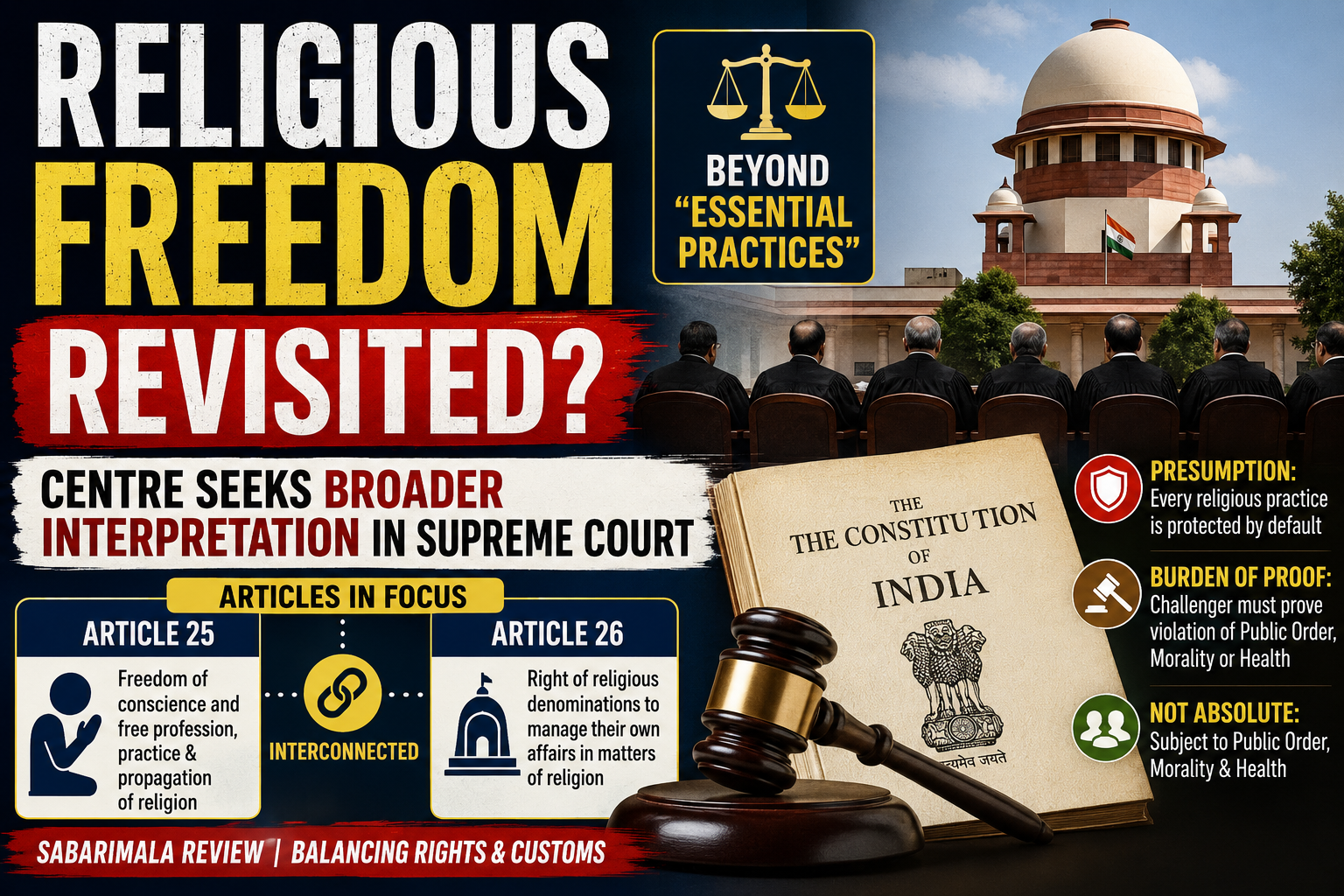
In a significant legal development before the Supreme Court, the Central Government has argued for a broader interpretation of religious freedom under the Indian Constitution. This case is crucial for students of Indian Polity and Constitutional Law, as it challenges decades of judicial precedent regarding how the state interacts with religious customs. The Core Argument The Solicitor General, representing the Centre, presented several key arguments before a nine-judge Bench: Beyond "Essential Practices": The Centre argued that constitutional protection for religion is not limited only to "essential religious practices" but has a much wider scope. Presumption of Protection: The Constitution presumes every religious practice is protected by default. Burden of Proof: The burden lies on the person challenging a practice to prove that it violates public order, morality, or health. Judicial Creativity: The Centre pointed out that the phrase "essential religious practices" does not actually appear in the text of the Constitution and is a product of previous court rulings. Constitutional Articles in Focus The hearing centers on the relationship between two specific articles: Article Purpose Article 25 Protects an individual's right to freedom of conscience and the right to freely profess, practice, and propagate religion. Article 26 Grants religious denominations the right to manage their own affairs in matters of religion. The "Interconnected" Argument: The Solicitor General submitted that these articles are not "isolated silos". Instead, Article 26 is seen as a collective manifestation of the individual rights guaranteed under Article 25. Context: The Sabarimala Review This hearing is part of a larger constitutional reference arising from the Sabarimala review petitions. The court is currently examining how to balance individual fundamental rights (like equality) with the collective rights of religious denominations to follow their traditional customs. Key Takeaways for Students Expanding Rights: Traditionally, the Supreme Court used the "Essential Religious Practices" test to decide which rituals were protected. The Centre is now pushing for an expansive interpretation, similar to how other fundamental rights (like the Right to Privacy) have been broadened over time. Three Grounds of Restriction: Even with a wider ambit, religious freedom is not absolute. It remains subject to three specific constitutional hurdles: Public Order, Morality, and Health. Judicial Review: This case highlights the tension between "judicial creativity" (the court creating its own tests) and the literal text of the Constitution.
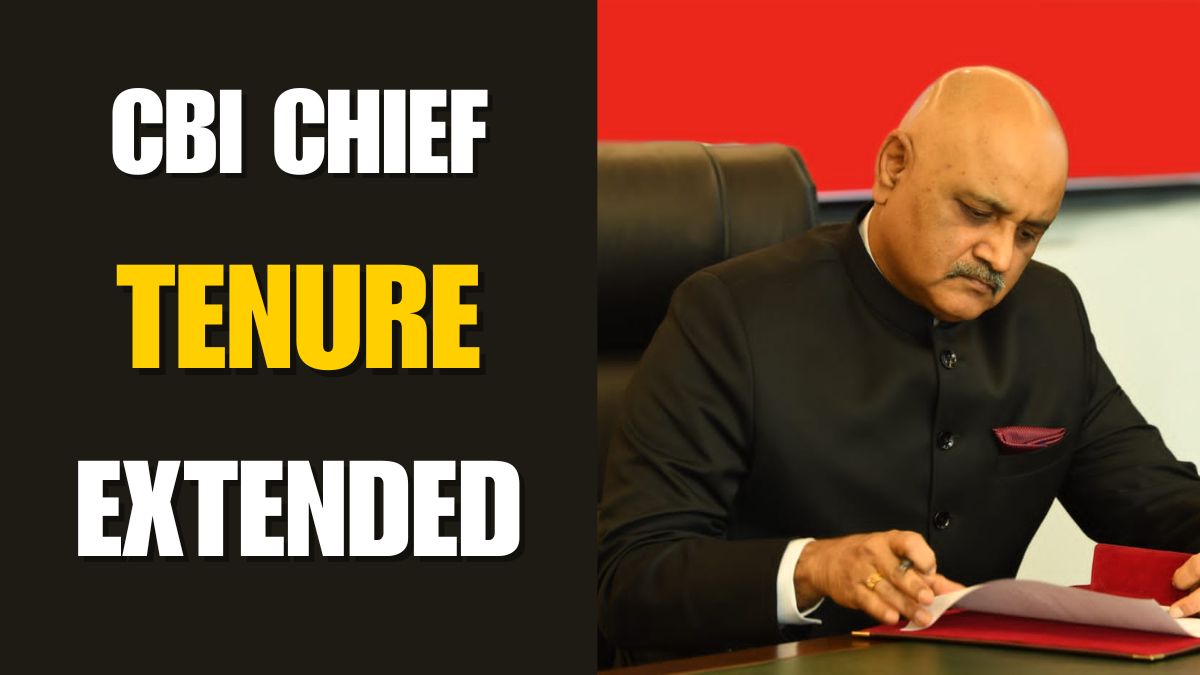
One-Year Extension for CBI Director Praveen Sood

One-Year Extension for CBI Director Praveen Sood

14 May 2026
CBI
In a significant administrative and political move, the Central Government has extended the tenure of Praveen Sood as the Director of the Central Bureau of Investigation (CBI) for another year. This development is a key topic for students of Indian administration and governance. The Appointment and Extension New Tenure: The Appointments Committee of the Cabinet (ACC) approved an extension for Mr. Sood beyond May 24, 2026. Background: Praveen Sood is a 1986-batch Indian Police Service (IPS) officer. He was originally appointed for a two-year term as CBI chief and received his first one-year extension in May 2025. Approval Process: The decision was based on recommendations from a high-powered Selection Committee. The High-Powered Selection Committee The process for appointing or extending the CBI Director involves a specialized committee to ensure transparency. This committee consists of: The Prime Minister (Chairperson). The Leader of Opposition (LoP) in the Lok Sabha. The Chief Justice of India (CJI) or a Supreme Court Judge nominated by the CJI. Political Context and Controversy The extension has been met with strong opposition from the Leader of Opposition, Rahul Gandhi, who submitted a formal dissent note during the panel meeting. Accusation of "Institutional Capture": Mr. Gandhi accused the government of using the agency to target political opponents, critics, and journalists. Procedural Concerns: The LoP alleged he was denied a meaningful role in the process. Specifically, he noted that he was not provided with the "self-appraisal" or "360-degree reports" of the 69 eligible candidates in advance. Transparency Issues: Gandhi argued that a detailed review of these records is essential to evaluate a candidate's performance history before making an appointment. Key Terms for Students Term Definition in Context ACC Appointments Committee of the Cabinet; the body that makes final decisions on top-level government appointments. 360-Degree Report A comprehensive evaluation system for officers that gathers feedback from superiors, peers, and subordinates. Dissent Note A formal document expressing disagreement with the majority decision of a committee or panel. Institutional Capture A situation where a public institution is steered away from its intended purpose to serve the interests of a specific group or party. Student Note: The CBI Director's tenure is governed by the Delhi Special Police Establishment (DSPE) Act, 1946. Recent amendments allow the government to extend the Director's tenure by one year at a time for up to five years in total.
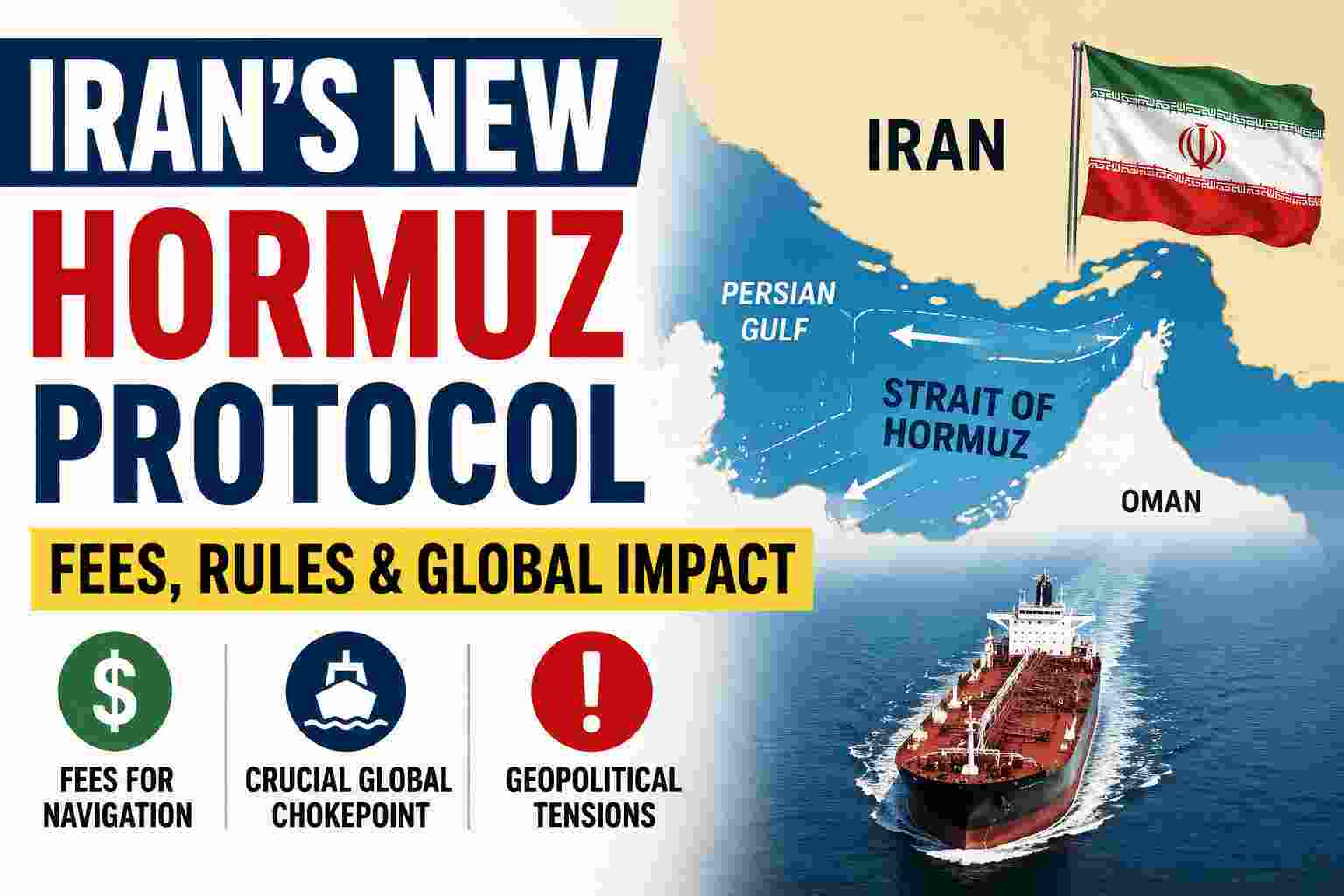
Iran’s Proposed Hormuz Protocol

Iran’s Proposed Hormuz Protocol

14 May 2026
Iran is developing a new regulatory framework for the Strait of Hormuz, one of the world's most critical maritime chokepoints. This move has significant implications for global trade, energy security, and international maritime law. The "Hormuz Protocol" Explained For decades, Iran and Oman have provided navigation services in the Strait of Hormuz free of charge. Iran now plans to formalize these services through a new "protocol." Financial Component: The protocol aims to introduce fees to cover costs Iran incurs for ensuring safe navigation, managing maritime pollution, and conducting rescue operations. Legal Standing: Iran is not a member of the 1982 UN Convention on the Law of the Sea (UNCLOS). Because of this, Iranian officials argue they have the right to implement their own protocols over the chokepoint. Non-Discriminatory (With Exceptions): While Iran claims the arrangement will be non-discriminatory, it has explicitly stated it will not cooperate with countries found supporting the U.S. and Israel. Geopolitical Tensions The announcement comes amid heightened regional friction and diplomatic maneuvering: BRICS Friction: During a BRICS Foreign Ministers' meeting, Iran accused a "neighboring country" (alluding to the UAE) of trying to block a joint statement by attempting to include language condemning Iran's military strategy. U.S.-Israel Conflict: Iran accused the U.S. and Israel of initiating conflict on February 28, 2026, during nuclear negotiations. U.S. Rejection: U.S. President Donald Trump has already dismissed Iran's proposals, calling them "totally unacceptable." Impact on India and Global Shipping India’s Status: Iran has assured that the Strait will remain open to Indian-linked ships. Global Risk: Iranian officials warned that general marine traffic will be severely affected if the U.S. resumes military attacks on Iran. Key Terms for Students Term Definition in Context Strait of Hormuz A narrow waterway between the Persian Gulf and the Gulf of Oman; a vital route for global oil shipments. Chokepoint A strategic narrow passage that can be easily blocked to stop the flow of traffic. UNCLOS United Nations Convention on the Law of the Sea; an international agreement that establishes a legal framework for all marine and maritime activities. BRICS An intergovernmental organization comprising Brazil, Russia, India, China, South Africa, Egypt, Ethiopia, Iran, and the UAE.  
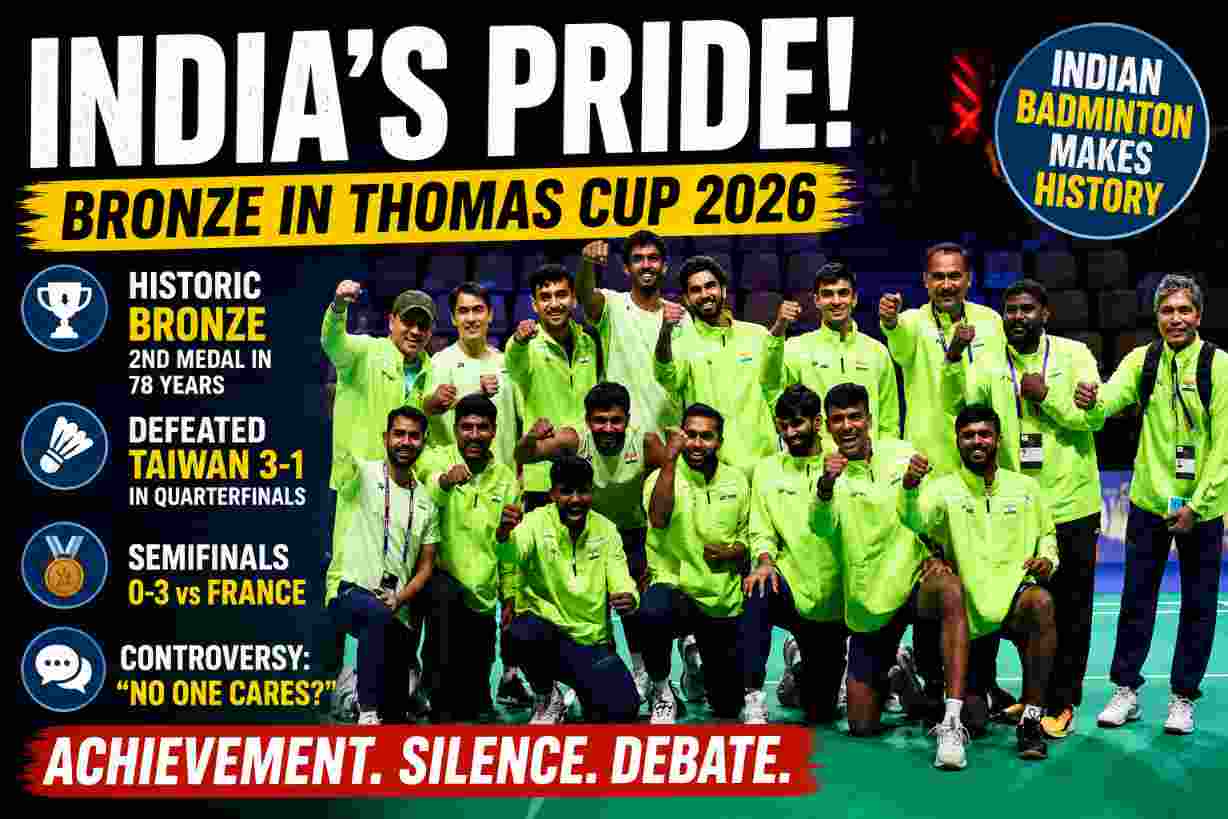
India’s Thomas Cup Bronze (2026)

India’s Thomas Cup Bronze (2026)

14 May 2026
Based on the recent performance and subsequent social media discourse surrounding the Indian men’s badminton team, here is a comprehensive breakdown of the event, the controversy, and its significance for Indian sports. The Achievement: A Podium Finish in Denmark Three weeks ago, the Indian men’s badminton team traveled to Horsens, Denmark, for the Thomas Cup (the world's premier men's team badminton championship). Despite being seeded eighth and arriving with a squad in transition, India secured a bronze medal. Historical Context: This is only the second time in the tournament’s 78-year history that India has won a medal (following the historic Gold in 2022). The Path to Bronze: Group Stage: India pushed powerhouse China to a narrow 2-3 loss, proving they could go toe-to-toe with the world's best. Quarterfinals: India defeated Taiwan 3-1. Key highlights included Lakshya Sen’s comeback against Chou Tien Chen and the emergence of 20-year-old Ayush Shetty, who clinched the winning point against Lin Chun-Yi. Semifinals: India fell 0-3 to France. The tie was hampered by an elbow injury to Lakshya Sen, leaving the team without its top singles player. The Controversy: "The Silence of the Fans" The victory was overshadowed by a viral Instagram post from doubles star Satwiksairaj Rankireddy. Upon returning to an empty airport with no crowds or media frenzy, he wrote: "As usual, no one knows what happened over the past two weeks, and it seems like no one really cares." The Debate: The post triggered a national discussion regarding the disparity in recognition between cricket and other sports. Satwik later clarified that his intent wasn't to seek money or "grand parades," but to advocate for a sporting culture that celebrates all global-level achievements, regardless of the discipline. Key Player Profiles & Transitions The 2026 campaign highlighted a shift in the hierarchy of Indian badminton: Player(s) Role/Status Performance Note Ayush Shetty Emerging Star The "breakout performer" who secured the semifinal spot; seen as the future of Indian singles. Lakshya Sen Leading Singles Provided vital wins but was sidelined in the semis due to elbow and foot injuries. Satwik & Chirag World-Class Doubles Remained the backbone of the team despite returning from a recent injury-hit phase. H.S. Prannoy & K. Srikanth The Veterans Played the role of "anchors," providing leadership despite physical wear and tear. Why This Bronze Matters While the 2022 Gold was seen as a "magical fortnight," the 2026 Bronze is arguably more significant for the following reasons: Consistency: It confirms that India is no longer an "outside" nation but a permanent member of badminton’s elite tier (alongside China, Indonesia, and Japan). Depth & Continuity: The emergence of Ayush Shetty proves that India is successfully renewing its talent pool before the older generation (Prannoy/Srikanth) declines. Global Landscape Change: The tournament also signaled the rise of France as a new badminton power, who beat Indonesia and Japan to reach their first-ever final. Summary Table Feature Details Tournament Thomas Cup 2026 Location Horsens, Denmark India's Result Bronze Medal (Semifinalist) India's Seed 8th Major Win 3-1 vs. Chinese Taipei (Quarterfinal) Major Loss 0-3 vs. France (Semifinal)
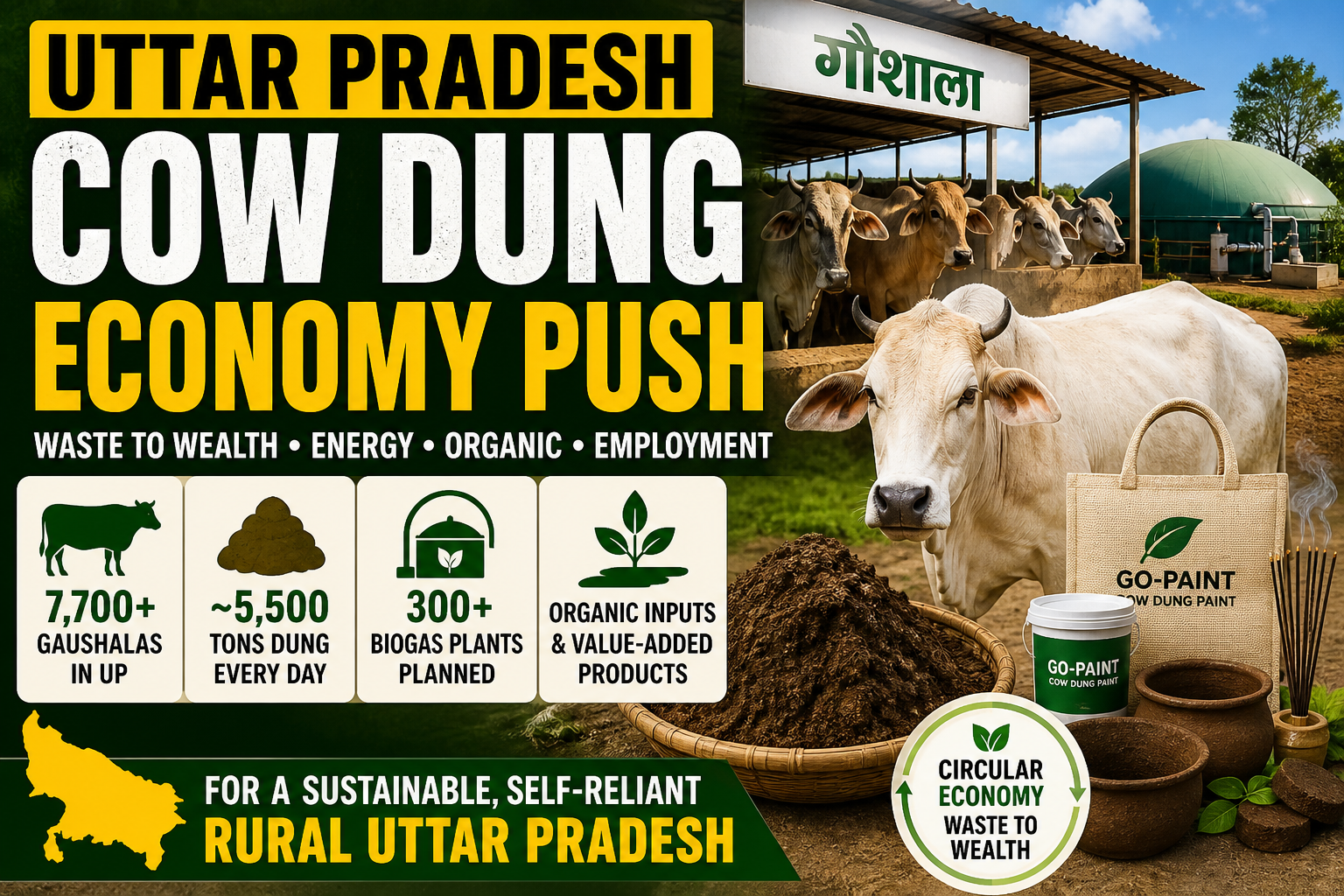
UP Promotes Cow Dung Economy

UP Promotes Cow Dung Economy

05 May 2026
1. Key Facts Latest Development (Date): May 5, 2026Animal Husbandry Minister Dharampal Singh chaired a high-level meeting and directed preparation of a comprehensive action plan for statewide expansion. Objective:Integrate animal husbandry with agriculture, make gaushalas self-reliant, increase farmer income, improve soil health, and promote waste-to-wealth model. Gaushalas in Uttar Pradesh:~7,700 gaushalas (increased from ~100 in 2017)Housing 11+ lakh cows Daily Cow Dung Availability:~5,500 tons/day (≈ 54 lakh kg) Biogas Initiative: Plan to install biogas plants in 300+ gaushalas Outputs: Bio-CNG, electricity, organic manure Natural Farming Expansion: ~94,000 hectares under cow-based natural farming 23,500 hectares in Bundelkhand (7 districts) Additional expansion planned along the Ganga belt ₹2,500 crore allocation (2025–26) Value-Added Products from Cow Dung: Go-Paint (cow dung paint) for government buildings Organic pots (polythene replacement) Incense sticks Vermicompost Jeevamrit, Ghanjeevamrit, Panchgavya Dung logs & bioplastics Implementation Agencies: Animal Husbandry Department Agriculture Department UP Gau Seva Aayog Cooperatives, SHGs, NGOs 2. Components of the Initiative (A) Energy & Fertilizer Production Biogas plants for clean energy Organic manure production from dung (B) Sustainable Agriculture Inputs Jeevamrit, Beejamrit Promotion of Zero Budget Natural Farming (ZBNF) (C) Livelihood Generation Rural employment via gaushala-based units Focus on women SHGs & rural youth (D) Market Linkage System Quality certification and standardization Cooperative-based marketing Government procurement (e.g., Go-Paint for offices) 3. Significance & Benefits Economic Benefits Increases farmer income Reduces dependency on chemical inputs Promotes rural entrepreneurship Makes gaushalas financially self-sustainable Agricultural Benefits Improves soil fertility and organic carbon content Reduces chemical fertilizer dependency Promotes sustainable farming practices Environmental Benefits Methane capture → clean energy Waste management improvement Reduction in pollution and plastic usage Social & Cultural Benefits Strengthens cow protection-linked economic model Promotes rural employment Aligns with Atmanirbhar Bharat and circular economy 4. Analysis (Mains-Oriented) Positive Aspects Strong example of circular economy model Converts waste (cow dung) into: Energy Fertilizer Industrial products Supports multiple SDGs: Zero Hunger Climate Action Decent Work Responsible Consumption Supports doubling farmer income strategy Culturally rooted yet economically modern Challenges Collection issue: Stray cattle dung management is difficult Infrastructure cost: Biogas and processing units require high investment Market limitation: Weak demand without strong awareness Quality control: Standardization of products required Scalability issue: Expansion across 75 districts needs coordination Way Forward Strengthen SHG + cooperative ecosystem Integrate with national schemes (Biogas, Natural Farming Mission) Invest in R&D for high-value products (bioplastics, bio-chemicals) Improve digital marketing & branding of cow-based products Expand skill development programs in rural areas 5. Exam Relevance Prelims Numbers (gaushalas, dung production, area under natural farming) Schemes and initiatives State-specific facts (UP) Mains Rural economy transformation Sustainable agriculture Livestock-based economy Circular economy model Environmental sustainability Essay / Interview Topics “Waste to Wealth Model in India” “Cow-Based Economy and Rural Development” “Sustainable Agriculture in India” 6. One-Liner Revision 👉 In May 2026, Uttar Pradesh advanced a cow dung economy model using 7,700+ gaushalas to convert ~5,500 tons/day of dung into biogas, organic inputs, and value-added products for promoting sustainable rural development and circular economy.