Daily Current Affairs

Stay ahead with organized updates across various categories.

Govt. plans security protocol for fishing harbours under CISF oversight

Govt. plans security protocol for fishing harbours under CISF oversight

29 May 2026
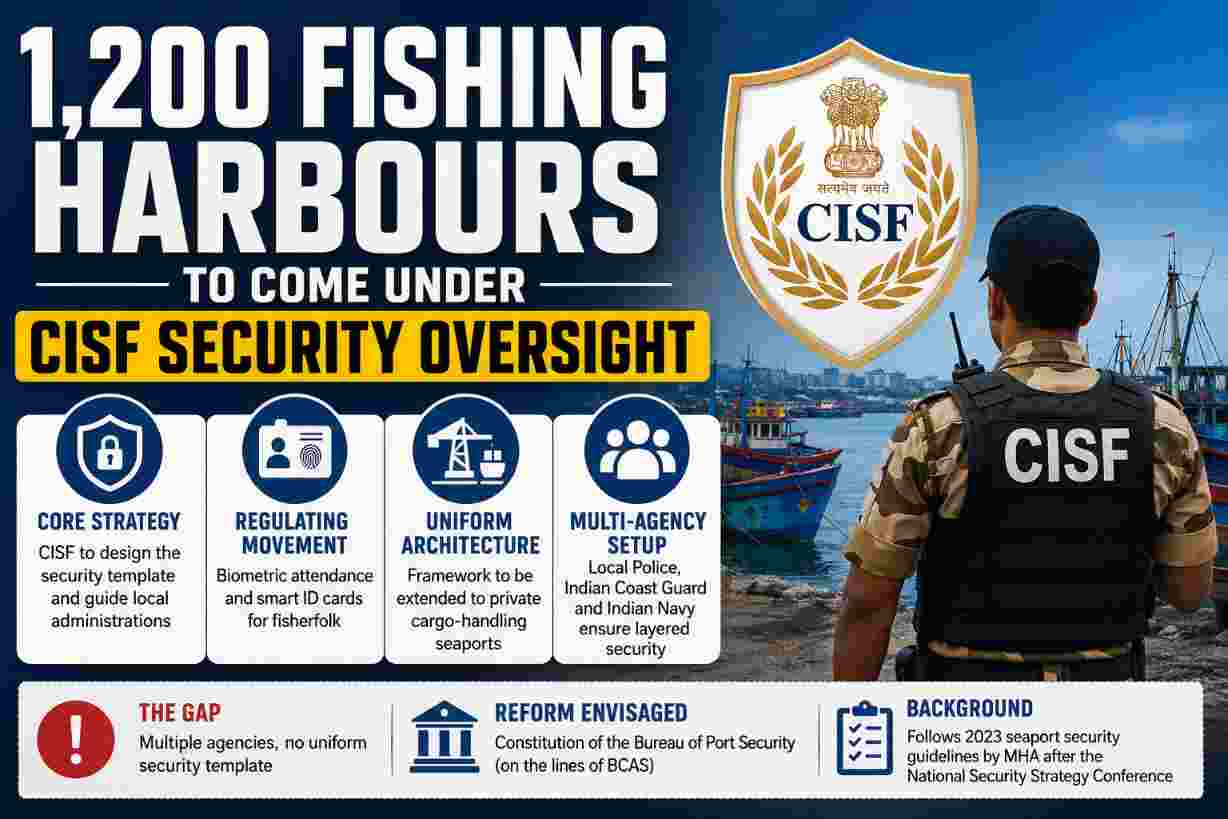
Syllabus Relevance: GS-III (Internal Security; Security challenges and their management in border areas) 1. Key Development The Union Ministry of Home Affairs (MHA) plans to bring nearly 1,200 fishing harbours and fish landing sites under the security oversight of the Central Industrial Security Force (CISF). This follows the prior designation of the CISF as the security regulator for over 250 seaports in the country. 2. Core Strategy & The CISF's Role Security Regulator: Physical deployment at all sites is not possible; CISF will instead design the security template and guide local administrations in managing protocols. Regulating Movement: Introducing a biometric attendance system and smart ID cards for fisherfolk. Uniform Architecture: The government intends to deploy this "sovereign entity" framework at private cargo-handling seaports as well. 3. Current Administrative Setup Total Hubs: There are 1,547 notified fish landing centres and fishing harbours across 13 coastal States and UTs. Dual Governance: States: Responsible for post-construction management, maintenance, and operation of harbours under their control. Center: Harbours under Central control are managed by Port Trusts (under the Ministry of Fisheries). Multiple Security Agencies: Deployment stretches from local police on land/shore, to the Indian Coast Guard, and the Indian Navy further out at sea. 4. Identified Gaps & Reforms Envisaged The Gap: The involvement of multiple agencies has resulted in the absence of a uniform security template. Bureau of Port Security: The MHA is planning the constitution of this dedicated body for the security of vessels and port facilities, modeled on the Bureau of Civil Aviation Security (BCAS). Background Guidelines: This follows the seaport security guidelines issued by the Home Ministry in 2023 after deliberations at the National Security Strategy Conference.
11th Quad Foreign Ministers’ Meeting (May 2026)

11th Quad Foreign Ministers’ Meeting (May 2026)

27 May 2026
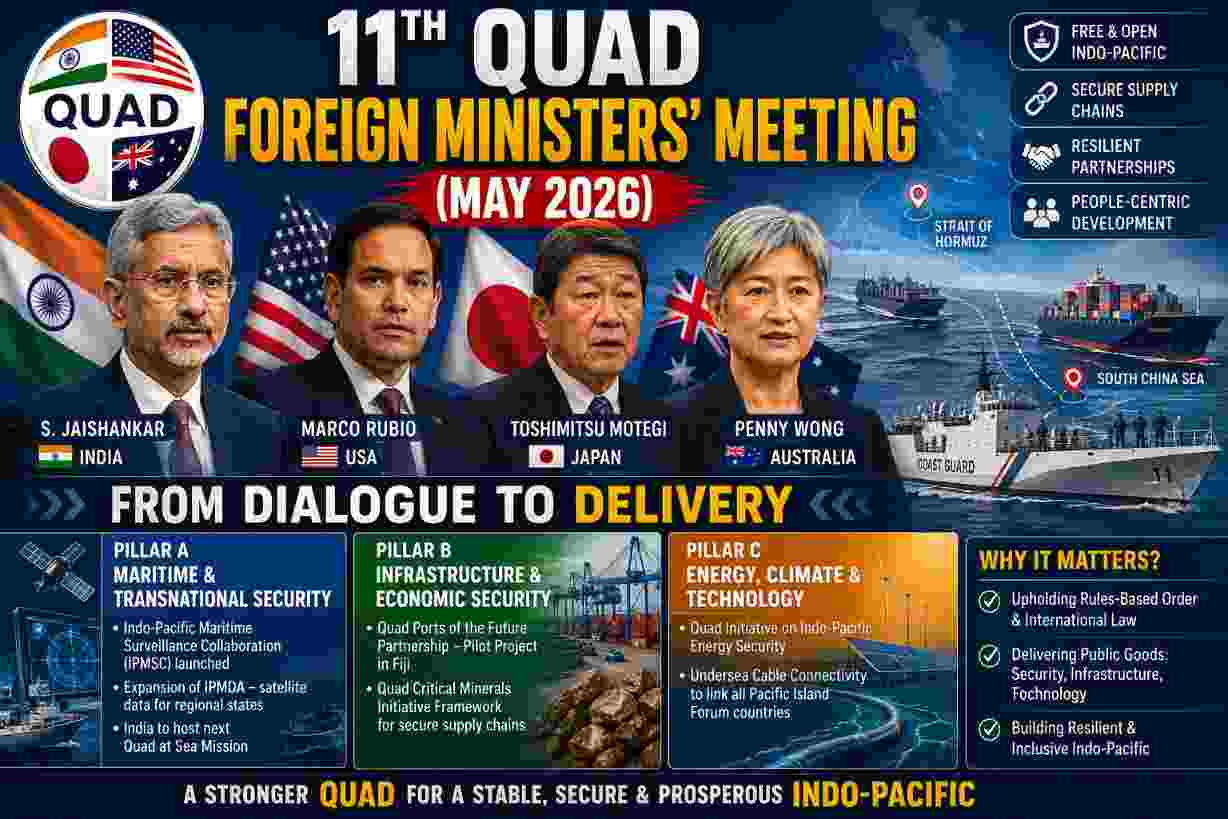
Syllabus Mapping: GS Paper II: International Relations (Bilateral, regional and global groupings involving India and/or affecting India's interests). 1. Core Context & Geopolitical Catalysts The meeting transpired against a backdrop of escalating threats to global supply chains and international maritime law: Persian Gulf & Strait of Hormuz: Heightened instability and non-state attacks on commercial shipping. Iran recently claimed the Strait of Hormuz is not an international waterway and stated it has no obligation to comply with the UNCLOS (UN Convention on the Law of the Sea). South China Sea: Continuous unilateral, coercive, and grey-zone tactics challenging freedom of navigation. 2. Major Outcomes & Strategic Initiatives The Quad framework shifted heavily from an abstract security dialogue toward tangible, delivery-oriented project execution across four primary pillars: Pillar A: Maritime & Transnational Security Indo-Pacific Maritime Surveillance Collaboration (IPMSC): A newly launched initiative designed to leverage and integrate the collective maritime surveillance assets of all four nations. Its primary focus is strengthening unclassified information sharing, starting initially with the Indian Ocean Region (IOR). Expansion of IPMDA: The existing Indo-Pacific Partnership for Maritime Domain Awareness is being scaled up to provide near-real-time commercial satellite tracking data to smaller regional littoral states. This will help them counter illegal, unreported, and unregulated (IUU) fishing and maritime trafficking. Quad at Sea Mission: India announced it will host the next iteration of this mission, physically bringing together the Coast Guards of all four nations onto a single vessel to normalize interoperability. Pillar B: Infrastructure & Economic Security Quad Ports of the Future Partnership: Launched to build resilient and high-capacity port systems. Australia announced its first pilot project under this banner to upgrade critical port infrastructure in Fiji (countering China's checkbook diplomacy in the Pacific Islands). Quad Critical Minerals Initiative Framework: A strategic pact aimed at coordinating public-private investments, mining, processing, and recycling technologies to build secure supply chains independent of single-country dependencies (China). Pillar C: Energy, Climate & Technology Quad Initiative on Indo-Pacific Energy Security: A cooperative framework intended to safeguard regional energy markets and downstream supply chains (e.g., fertilizers) against global shockwaves. Undersea Cable Connectivity: Reaffirmed commitments to map and deploy resilient digital infrastructure, aiming to connect all Pacific Island Forum countries via undersea data cables. 3. Analytical Breakdown (Mains Perspective) Arguments for Strengthening the Quad (Pros) Preserving Rules-Based Order: Directly challenges exceptionalist claims (like Iran's UNCLOS rejection or China’s Nine-Dash Line) by asserting freedom of navigation in global choke points. Public Goods Provider: By focusing on satellite tracking data, disaster management (via the Indo-Pacific Logistics Network), and port upgrades in Fiji, the Quad presents itself as a constructive regional partner rather than an aggressive military alliance. Securing India’s Strategic Autonomy: Allows India to deepen critical technological and military interoperability with major global powers without entering into a binding, formal mutual-defense treaty. Key Challenges & Constraints The "Militarization" Narrative: Groupings like China routinely criticize the Quad as an "exclusive bloc" or an Asian NATO aimed at containment. The MEA has to consistently defend that initiatives like IPMSC are non-military and public-centric. Diverging National Priorities: The four members have varied degrees of economic coupling with China and distinct core strategic anxieties (e.g., India's continental border threat vs. Australia/Japan's maritime-centric focus). Implementation Gaps: While Ministerial Meetings (FMM) are frequent, the delay in high-level Leaders' Summits occasionally stalls rapid geopolitical alignment. 4. Way Forward for India Leverage for Domestic Capacity: India must utilize the Critical Minerals Framework and the Energy Security Initiative to secure its domestic manufacturing sector (Production Linked Incentive schemes) and ensure affordable energy transition for its population. Maintain ASEAN Centrality: India must actively communicate and run collaborative exercises alongside ASEAN and the Indian Ocean Rim Association (IORA) to neutralize accusations of western-driven regional exclusion. Enforce UNCLOS Interoperability: Use the upcoming Indian-hosted Quad at Sea Coast Guard mission to establish clear, standardized legal responses against non-state and state-sponsored disruptions at maritime choke points. UPSC Mains Answer Writing Pointer: If asked about the changing nature of the Quad, highlight that the grouping is shifting from a "security-centric discussion club" to a "critical infrastructure, digital, and resource-sharing network" to offer tangible alternatives to regional countries.

Operation Ragepill: Massive Drug Crackdown

Operation Ragepill: Massive Drug Crackdown

17 May 2026
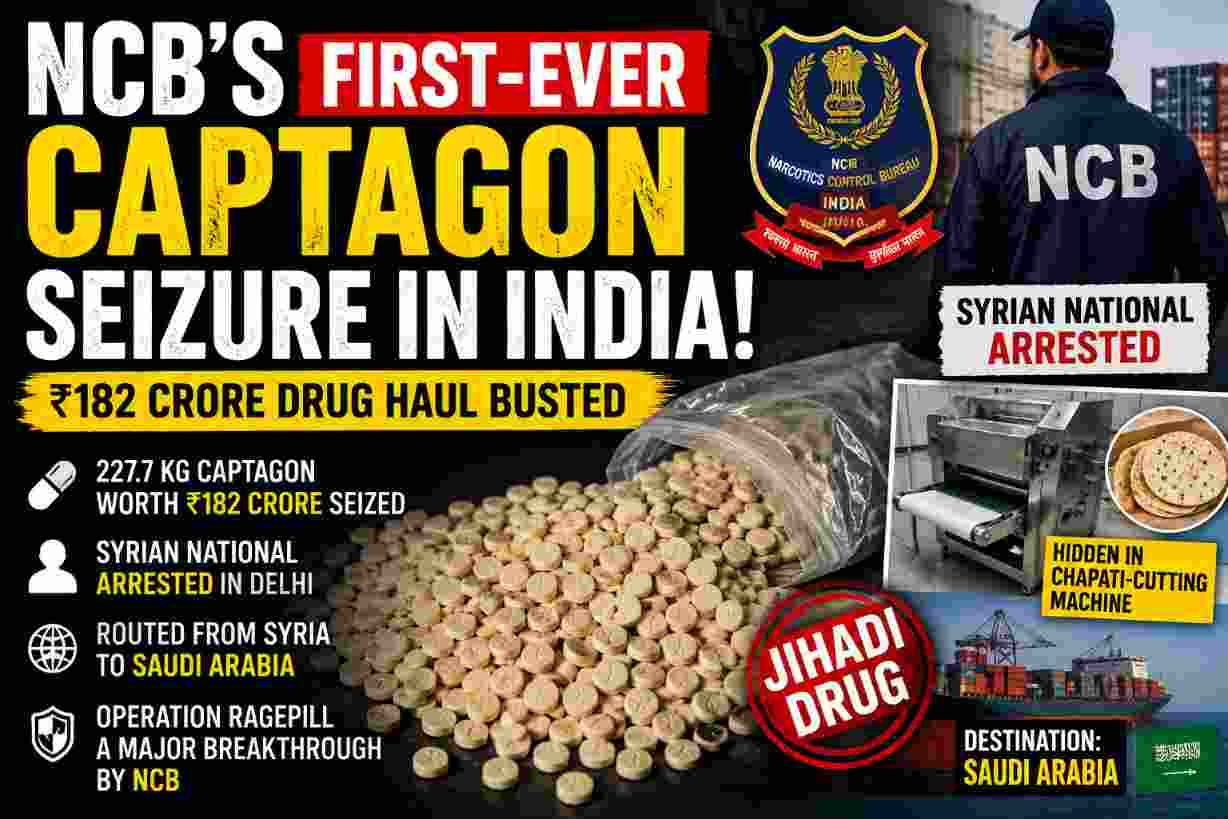
Why in News? The Narcotics Control Bureau (NCB) busted an international drug trafficking syndicate and seized 227.7 kg of Captagon worth around ₹182 crore. A Syrian national was arrested during the operation named “Operation Ragepill.” Key Highlights Major Seizure First-ever seizure of Captagon in India. Total drugs seized: 31.5 kg from Delhi’s Neb Sarai 196 kg from Mundra Port, Gujarat Estimated value: ₹182 crore Arrest Syrian national Alabras Ahmad arrested. He entered India on a tourist visa in November 2024. Visa expired in January 2025; he was staying illegally. Smuggling Route Drugs were allegedly being routed: Syria → India → Saudi Arabia & West Asia Captagon tablets were hidden inside: a chapati-cutting machine a shipment declared as sheep wool What is Captagon? About Captagon is a synthetic stimulant drug. Main ingredient: Fenethylline Produces: high alertness euphoria reduced fatigue Why Called “Jihadi Drug”? Reportedly abused in conflict zones and by extremist groups in West Asia. Linked to illegal drug networks in the Middle East. Operation Ragepill Conducted by the Narcotics Control Bureau. Based on intelligence shared by a foreign drug law-enforcement agency. Demonstrates growing international cooperation against narcotics trafficking. Government Statement Amit Shah reiterated the government’s policy of “Zero Tolerance Against Drugs” and emphasized the vision of a Drug-Free India. Exam Relevance Prelims Captagon Fenethylline NCB International drug trafficking routes Operation Ragepill Mains Internal Security / International Relations India as a transit point for narcotics Challenges of transnational organized crime Need for global cooperation in anti-drug operations
India Rejects Hague Arbitration Award on Indus Waters Treaty

India Rejects Hague Arbitration Award on Indus Waters Treaty

17 May 2026
What happened? India has rejected a reported award issued by the Court of Arbitration (CoA) at The Hague regarding hydroelectric projects on the Indus river system. The dispute mainly concerns the Kishenganga and Ratle hydroelectric projects being built by India. India stated that it does not recognise the tribunal as legally constituted and therefore considers all its decisions “null and void.” Background: The Indus Waters Treaty The Indus Waters Treaty was signed in 1960 between India and Pakistan with the World Bank as a mediator. River Allocation India: Ravi, Beas, Sutlej (Eastern Rivers) Pakistan: Indus, Jhelum, Chenab (Western Rivers) India is allowed limited use of western rivers for: Hydropower generation Irrigation Non-consumptive purposes Why is Pakistan objecting? Pakistan challenged the design features of: Kishenganga Hydroelectric Project Ratle Hydroelectric Project The main issue is “pondage” — the amount of water that can be stored temporarily in run-of-river hydroelectric plants. Pakistan argues: India’s designs may allow excessive water control. This could affect downstream water flow into Pakistan. What is the Court of Arbitration (CoA)? The CoA is a five-member arbitration panel constituted in 2023 at Pakistan’s request. India refused to participate because: India believes the matter is technical, not legal. Under the treaty, technical disputes should first go to a Neutral Expert. A Neutral Expert process was already underway through the World Bank. India argues that running both mechanisms simultaneously violates the treaty framework. India’s Position External Affairs Ministry spokesperson Randhir Jaiswal said: The tribunal is “illegally constituted.” Any award issued is invalid. India’s decision to keep the treaty “in abeyance” remains effective. India has increasingly argued that: Pakistan repeatedly uses dispute mechanisms to delay Indian projects. The treaty needs modification due to changed geopolitical and security realities. What did the tribunal reportedly decide? According to reports: The tribunal interpreted treaty provisions largely in Pakistan’s favour. It reportedly restricted how India calculates permissible pondage. It narrowed India’s design flexibility for run-of-river projects. This could potentially limit operational freedom for future Indian hydropower projects. Why is this important? 1. India-Pakistan Relations Water-sharing is one of the few long-standing agreements that survived multiple wars and crises between the two countries. 2. Strategic Importance Hydroelectric projects in Jammu & Kashmir are strategically important for: Energy generation Regional development Water management 3. Treaty Interpretation Conflict The case highlights a deeper disagreement over: Who has jurisdiction? How disputes should be resolved? Whether treaty mechanisms can run simultaneously. Key Terms Pondage Temporary water storage used to regulate flow for hydropower generation. Run-of-River Project A hydropower plant that generates electricity without creating a large reservoir. Neutral Expert A technical specialist appointed under the treaty to resolve engineering/design disputes. Exam Relevance UPSC / State PCS Topics Covered: India-Pakistan relations International water treaties International arbitration Hydroelectric power Indus river system Possible Questions Discuss the significance of the Indus Waters Treaty in India-Pakistan relations. Why has India objected to the Court of Arbitration on the Indus dispute? Explain the concept of pondage in run-of-river hydropower projects.
Fuel Price Hike and Windfall Tax Rationalization

Fuel Price Hike and Windfall Tax Rationalization

16 May 2026
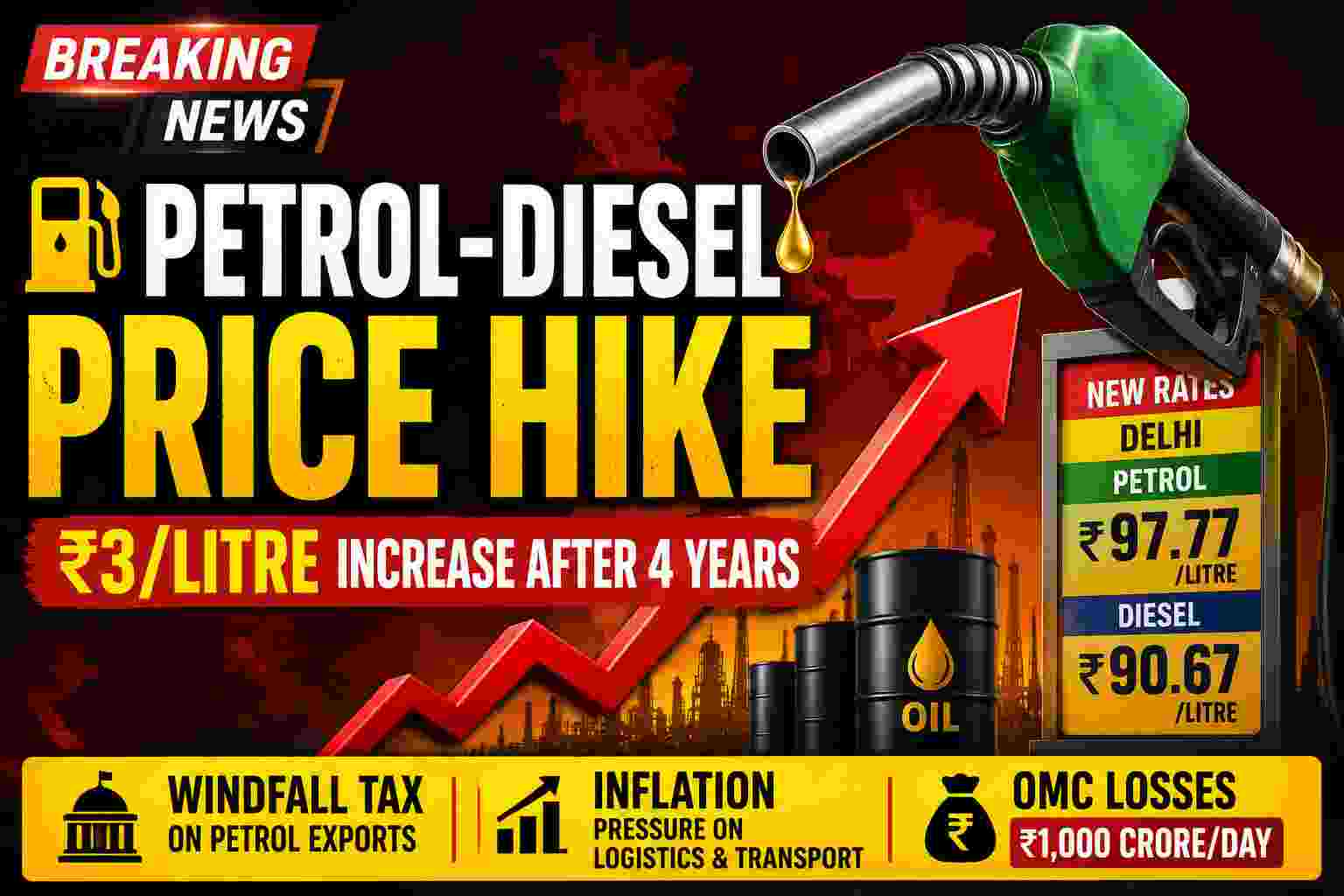
1. Context Retail Hikes: Petrol and diesel prices hiked by ₹3 per litre across all variants. Compressed Natural Gas (CNG) prices increased by ₹2 per kg. Historical Context: This marks the first major retail fuel price hike (defined as >₹1/litre) in over four years, since the staggered ₹9 hike following the March 2022 Russia-Ukraine conflict. New Base Rates (Delhi): * Regular Petrol: ₹97.77 / litre Regular Diesel: ₹90.67 / litre 2. Fiscal Measures: Windfall Tax Adjustments Simultaneously, the Central Government restructured the windfall gains tax regime to regulate outbound shipments and domestic availability: Petrol Exports: New windfall tax of ₹3 per litre imposed. Diesel Exports: Levy reduced to ₹16.5 per litre. Aviation Turbine Fuel (ATF): Levy reduced to ₹16 per litre. 3. Under-Recoveries & OMC Financial Strain The Macro Loss: Prior to this decision, State-run Oil Marketing Companies (OMCs like IOCL, BPCL, HPCL) were bearing combined losses of approximately ₹1,000 crore per day across petrol, diesel, and LPG. Global Catalysts: Severe upstream financial pressure caused by global crude oil spikes, soaring freight rates, and supply-chain re-routing born out of the ongoing conflict in West Asia. The Fiscal Gap: Structural under-recoveries stood at ₹13–15/litre for petrol and ₹17–18/litre for diesel. Experts note the ₹3 hike is only a partial buffer; a ₹10 per litre hike is required to bridge even 50% of the OMCs' true under-recoveries. 4. Strategic Multi-Dimensional Impact Consumer Inflation Risks: While a ₹3 hike offers a breather to corporate OMC balance sheets, it introduces cascading input-cost pressures across logistics, public transport, and agricultural supply chains. Demand-Side Management: Aligns with the political executive’s recent public push urging citizens to voluntarily curb fuel consumption to ease India's high crude import bill. The "Export vs Domestic" Balance: Imposing a windfall tax on petrol exports acts as a regulatory disincentive for domestic refiners private or public to prioritize lucrative international markets over domestic fuel pumps during a global energy crunch. What is Windfall Tax? A windfall tax is a higher, temporary tax levied by a government on specific companies or industries that have experienced sudden, exceptionally high, and unexpected profits. These extraordinary gains are called "windfalls" because they do not result from any strategic investment, expansion, or sudden business innovation by the company itself. Instead, they are entirely driven by external economic shocks or geopolitical events beyond the company's control. 1. Why Do Governments Impose It? Redistributing Excess Wealth: It ensures that companies profiting massively from a crisis contribute a fair portion back to the economy, rather than keeping all the gains. Funding Public Relief: The extra revenue generated is often channeled directly into funding public welfare programs, infrastructure development, or consumer subsidies to ease the burden of the crisis on the general public. Fiscal Balancing: It provides governments with emergency revenue during times of crisis (such as wars or high import bills) without having to raise regular taxes on ordinary citizens.
Bhojshala Case Verdict: MP High Court Judgment

Bhojshala Case Verdict: MP High Court Judgment

16 May 2026
1. The Core Ruling (May 2026) Judicial Decision: The Indore Bench of the Madhya Pradesh High Court ruled that the disputed 11th-century Bhojshala-Kamal Maula Mosque complex in Dhar is a Hindu temple dedicated to Goddess Vagdevi (Saraswati). Quashing of 2003 Order: The court struck down the April 2003 Archaeological Survey of India (ASI) arrangement that divided access (Hindus on Tuesdays/Basant Panchami; Muslims on Fridays). Exclusive Worship Rights: The Hindu community has been granted continuous daily rights to perform worship rituals at the site; Friday namaz is no longer permitted. 2. Key Legal & Scientific Evidence ASI Scientific Survey: The judgment relied heavily on a multi-volume ASI report utilizing advanced techniques (carbon dating, GPR, XRF spot analysis, and palaeography). Structural Findings: The survey concluded that the current standing structure was constructed centuries later using the dismantled, recycled remains of an 11th-century monumental complex from the Paramara dynasty. Recovered Artefacts: Excavations revealed sculptures and iconography representing Hindu deities (Ganesha, Brahma, Narasimha, Hanuman, Krishna) alongside Jain Tirthankara imagery. Reused basalt pillars showed Arabic/Persian inscriptions carved on older temple components. Historical Continuity: The court recorded that the site historically served as a Bhojshala (a prominent center for Sanskrit learning) under Raja Bhoj, and noted that the continuity of Hindu worship at the site had never been legally extinguished. 3. Key Directives Issued by the Court Administration & Upkeep: The court handed over full supervisory control, conservation, and regulation of religious access to the ASI and directed the Central Government to manage the site as a Bhojshala temple and Sanskrit learning center. Repatriation of the Deity: The Union Government has been directed to consider active representations to bring back the original Pratima (idol) of Goddess Saraswati/Vagdevi, currently housed in the British Museum in London, and re-establish it at the site. Alternate Land for Mosque: To secure religious equity, the court stated that the state government may consider allocating an alternate, suitable piece of land within Dhar district for the Muslim community to construct a mosque. 4. Constitutional & Jurisprudential Grounding Articles 25 & 26 Alignment: The Bench noted that under the Constitution, the State has an obligation to protect ancient monuments of historical and spiritual significance, including the preservation of the sanctum sanctorum and the purity of the deity. Ayodhya Principles: The 242-page judgment drew from the 10 principles of the Supreme Court's Ram Janmabhoomi verdict, reiterating that courts can safely rely on multidisciplinary, transdisciplinary archaeological studies when determining the historical character of a site. Rejection of the 1935 Proclamation: The court dismissed the Muslim side's reliance on a 1935 official proclamation (Ailaan) by the princely State of Dhar naming it a mosque, noting it lacked legal validity as the site was already a protected monument under the 1904 Ancient Monuments Preservation Act.
India, UAE Seal Major Oil Storage and Defence Agreements

India, UAE Seal Major Oil Storage and Defence Agreements

16 May 2026
1. Event Overview Context: Prime Minister Narendra Modi’s state visit to the UAE (Abu Dhabi) as part of a 5-nation tour (including the Netherlands, Sweden, Norway, and Italy). Geopolitical Stance: India explicitly condemned recent regional attacks on the UAE, praising its "restraint" and offering support for regional peace efforts. 2. Key Pillar: Strategic Energy Security To fortify India's energy cushions against external shocks, the Abu Dhabi National Oil Company (ADNOC) and Indian Strategic Petroleum Reserves Ltd. (ISPRL) signed two major MoUs: Strategic Reserves: Agreement for storing up to 30 million barrels of crude oil in India's underground strategic reserves. Reciprocal Storage: Exploration of potential Indian crude oil storage facilities within the UAE. Supply Stability: Concluded pacts on long-term LNG (Liquefied Natural Gas) supplies to diversify India’s fuel basket. 3. Key Pillar: Strategic Defence Cooperation Framework An institutional framework proposed during January was officially concluded to upgrade the bilateral security relationship: Industrial & Tech Alliance: Deepened collaboration in defence manufacturing, technology transfer, and joint industrial production. Operational Interoperability: Increased scale of joint military exercises, specialized training, and special forces operations. Modern Security Domains: Enhanced intelligence sharing and coordination in maritime security, cyber-defence, and information exchange. 4. Key Analytical Takeaways The "West Asia" Pivot: Amid the broader West Asia crisis (which dragged down India's regional trade volumes in April 2026), these pacts show India actively using deep bilateral diplomacy to insulate its vital energy supply lines. Strategic Depth via Storage: Relying on the UAE to fill India's commercial and strategic petroleum reserves provides a cushion against price volatility and transit chokepoint disruptions. Beyond Buyer-Seller Relations: The shift from simple oil procurement to joint defence manufacturing and cyber-warfare capabilities marks a transition from a transactional relationship to a comprehensive strategic partnership.
India April 2026 Exports Rise to $43.6B Amid Trade Diversification

India April 2026 Exports Rise to $43.6B Amid Trade Diversification

16 May 2026
India’s April 2026 merchandise exports grew 14% to $43.6B. Driven by market diversification and strong services, the overall trade deficit fell 30% to $7.8B. Trade Performance 1. Data Merchandise Trade: Exports grew ~14% to $43.6 billion (vs $38.3B in April 2025); Imports rose to $71.9 billion. Services Trade: Exports jumped to $37.2 billion; Imports marginally dipped to $16.7 billion. Net Deficit: The overall trade deficit (Goods + Services) shrank by 30% to $7.8 billion, thanks to a strong services surplus cushioning the goods deficit. 2. Core Trends & Drivers Price Effect: Rising global commodity prices artificially boosted the nominal value of exports. Supply Resilience: Industry successfully maintained domestic supply chains despite global maritime bottlenecks. Market Diversification: Exporters hedged risks by shifting focus to non-traditional and historically smaller destinations. 3. Shift in Export Destinations India recorded massive growth spikes in alternate markets to counter traditional slowdowns: Asia-Pacific & Neighborhood: Sri Lanka (+215%), Singapore (+179%), Bangladesh (+64%), and Vietnam (+53%). Africa: Exports to Tanzania surged 158% to reach $1.2 billion. 4. Geopolitical Shock: West Asia Crisis Regional conflict heavily depressed trade volumes along traditional Middle Eastern/Red Sea routes: Exports to West Asia: Dropped 28% to $4.16 billion. Imports from West Asia: Fell 31.6% to $10.5 billion (reflecting lower/disrupted energy and raw material inflows). 5. Key Takeaways Services as a Macro Buffer: The widening gap in merchandise trade is systematically absorbed by India's structural strength in service exports, keeping the overall external balance stable. Volume vs. Value: Growth driven by global price inflation is a temporary cushion. Long-term export stability requires scaling up real cargo volumes, lowering logistics overheads, and expediting bilateral trade pacts. Transit Vulnerabilities: The sharp drop in West Asian trade underlines India's extreme exposure to strategic maritime chokepoints, stressing the urgency for viable, multi-modal transport corridors.
PLFS 2025 Highlights Rise in Jobs and Women Workforce Participation

PLFS 2025 Highlights Rise in Jobs and Women Workforce Participation

15 May 2026
The recently released Periodic Labour Force Survey (PLFS) 2025 highlights important changes in India’s employment situation. Every year, nearly 7–10 million young Indians enter the labour market, making job creation and skill development critical for the country’s economic future. According to the report, India’s Labour Force Participation Rate (LFPR) reached 59%, while the unemployment rate remained low at 3%. Youth unemployment has also declined compared to 2024, showing improvement in both rural and urban areas. One of the biggest positive trends is the rise in women’s participation in the workforce. Female labour participation, especially in rural areas, increased steadily during 2025. The report also shows improvement in the quality of jobs, as regular salaried employment increased from 22% to 24%, while dependence on self-employment slightly declined. Women’s earnings also improved across salaried jobs, self-employment, and casual labour. However, gender wage gaps still remain a major concern. Women continue to earn less than men in most sectors. The report also points towards structural changes in the economy. Agriculture’s share in employment has declined, while manufacturing and services are creating more opportunities, especially for young people and women. Despite these positive developments, several challenges continue: Many graduates still struggle to find jobs after completing higher education. Only a small percentage of people have formal vocational or technical training. Women often leave the workforce because of childcare and household responsibilities. Around 25% of youth aged 15–29 belong to the NEET category (Not in Education, Employment, or Training). Experts suggest that India must focus on skill development, apprenticeships, women-friendly workplace policies, and expansion of stable salaried jobs to fully utilise its demographic dividend. Why is this important? Shows India’s employment and unemployment trends Highlights progress in women’s workforce participation Explains challenges in job creation and skill training Important for understanding India’s demographic dividend Key Points PLFS 2025 shows unemployment rate at 3%. Labour Force Participation Rate reached 59%. Women’s participation in workforce improved. Manufacturing and services sectors are growing. Skill gaps and NEET youth remain major concerns.